
Every few months, crypto social media picks up the same gloomy headline: “Altcoin season is cancelled.” Bitcoin leads the market, most altcoins lag behind, and timelines fill with charts showing flat lines where people hoped for rockets.
If you hold bags from the last cycle, it can feel like the party ended and never restarted. Yet many market analysts, traders, and builders argue that the current structure still points to a bullish setup for altcoins, just on a slower timetable and with a different shape than in past cycles.
That matters whether you care about short‑term trades or long‑term positions. Short‑term traders hunt the best altcoins to buy now, trying to time rotation out of Bitcoin. Long‑term investors put more weight on fundamentals as they build a basket of what they see as the best altcoins to invest in for the next several years. Both groups are staring at the same charts and asking the same question:
Is altcoin season really cancelled… or is it quietly loading in the background?
What People Mean When They Say “Altcoin Season Is Cancelled”
The phrase usually appears when three things happen at once:
- Bitcoin dominates performance for weeks or months
- Altcoins fail to follow through on rallies and keep making lower highs
- Sentiment turns bitter, with traders insisting that altcoins “never recover”
In past cycles, the pattern often looked clearer:
- Bitcoin ran hard
- Bitcoin cooled off and ranged
- Capital rotated into Ethereum and other large‑caps
- Then into mid‑caps and small‑caps, creating a wide altcoin bull run
When that clean rotation fails to appear right away, many assume this time is different and altcoin season is gone for good. The reality is usually more nuanced: cycles can stretch, regulatory and macro conditions can slow rotation, and capital may flow in waves rather than one clean surge that lifts everything at once.
Bitcoin Dominance: The First Clue Altcoin Season Isn’t Dead
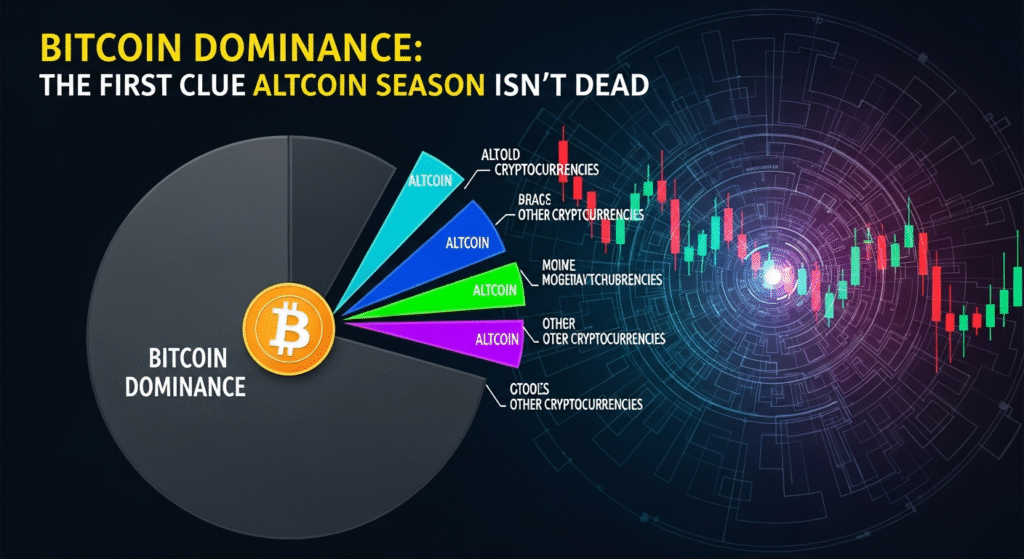
A core metric for judging altcoin conditions is Bitcoin dominance the share of total crypto market capitalization sitting in BTC.
Classic Dominance Pattern
Historically, many altcoin rallies have followed a basic script:
- Bitcoin rallies strongly and dominance rises
- Bitcoin cools off, but overall market interest stays high
- Dominance stalls or rolls over
- Capital shifts into altcoins, first majors, then down the risk curve
When dominance remains high and climbing, broad altcoin season is less likely. When dominance flatlines or starts drifting down while total market cap holds firm, that often signals improving conditions for altcoins.
Why Rising Dominance Doesn’t Prove Altcoin Season Is Cancelled
A high dominance reading can mean:
- Institutions are still primarily focused on BTC
- New capital is entering through Bitcoin first
- Regulatory clarity is stronger around BTC than other assets
None of those automatically mean altcoins are finished. They often mean timing has shifted. Bitcoin may need to stabilize, or macro uncertainty may need to ease, before traders feel comfortable taking on more risk further out on the curve.
For traders searching the best altcoins to buy now, that means patience. A strong Bitcoin phase can build the foundation for a later rotation, even if it feels like altcoins are standing still.
Liquidity and Volume: Are Altcoins Even in the Game?
Even if Bitcoin dominance begins to soften, altcoins need liquidity and volume to sustain any kind of season.
Signs of a Healthy Altcoin Market
Analysts often watch for:
- A rising share of total crypto volume in altcoins beyond BTC and ETH
- Consistent spot volume in major altcoin pairs, not just one or two meme tokens
- Reasonable depth on order books for leading projects
- Active markets on both centralized and decentralized venues
If only a handful of speculative coins see real volume while the rest remain quiet, the setup is fragile. When volume broadens out across multiple sectors DeFi, gaming, infrastructure, layer‑2s that is more typical of a lasting altcoin phase.
Why Thin Volume Makes People Think “Cancelled”
Even good projects can look lifeless when volume is low. A few large sells can drag charts down; breakouts fail easily because there is not enough demand behind them. This is when the “altcoin season cancelled” narrative gets loudest.
However, low volume often says more about short‑term attention than long‑term prospects. Many long‑term investors actually prefer quieter conditions to build positions, especially in projects they regard as some of the best altcoins to invest in for the next leg of the crypto market cycle.
On‑Chain and Builder Activity: The Quiet Bullish Case
Price is loud. Builders are quiet. When headlines complain about cancelled altcoin seasons, analysts often check what is happening under the hood.
Key signals include:
- Active addresses and transactions on major smart contract chains
- Fees and revenue being generated by DeFi protocols
- Total value locked (TVL) across top ecosystems
- Developer activity: commits, code releases, hackathons, grants
If these metrics are growing or at least holding steady while prices remain muted, it suggests altcoin networks are still gaining structure and user bases. That trend rarely gets attention in daily price debates, yet it is exactly what many long‑term investors want to see before calling something one of the best altcoins to invest in.
In other words, price can sleep while usage slowly builds. That is a classic backdrop for an eventual rotation once market attention shifts again.
Sentiment, Headlines and the Contrarian Setup
Crypto history is full of emotional extremes:
- At tops, traders insist this time there is no risk
- At bottoms, traders insist nothing will ever recover
“Altcoin season cancelled” sits closer to that second extreme. It is a sentiment statement, not a technical one. Experts who remain bullish on altcoins often see this kind of despair as part of the preparation phase, not the end of the story.
Common contrarian signals include:
- Major coins with strong fundamentals trading far below previous highs while networks keep growing
- Quality projects getting little discussion compared with quick‑flipping meme coins
- Influencers declaring large categories (like DeFi or gaming) “dead” while builders continue shipping products
None of this guarantees that an altcoin bull run is imminent. It does show that pessimism can be overdone precisely when long‑term setups are quietly improving.
How to Think About the Best Altcoins to Buy Now (Short Term)
For short‑term traders, the phrase best altcoins to buy now usually refers to coins or tokens that combine:
- A favorable chart structure
- Rising volume and interest
- Reasonable liquidity
- Clear upcoming catalysts (product releases, listings, major upgrades)
In a market where many assume altcoin season is cancelled, these candidates may appear in clusters around strong narratives: layer‑2 scaling, real‑world assets, liquid staking, or new DeFi primitives.
Short‑term traders often build a watchlist and wait for conditions such as:
- Bitcoin entering a range rather than setting new highs every week
- Funding rates on altcoin futures moving from extreme to moderate levels
- A shift in market discussion from “BTC only” back to “which sectors lead next”
In that environment, having a prepared list of what you regard as the best altcoins to buy now allows you to act with a plan instead of chasing every sudden green candle.
Note: Nothing here is financial advice. Markets are risky, and any coin—no matter how strong it looks can drop sharply.
Building a Watchlist of the Best Altcoins to Invest In (Long Term)
Long‑term investors think differently. For them, the emphasis is on finding the best altcoins to invest in over multiple years, not just the next few weeks.
A structured approach often includes:
Focus on Real Value
Questions to ask for each candidate:
- Does the project solve a real problem scalability, security, user experience, capital efficiency?
- Is there clear product‑market fit or at least early traction?
- Are there signs of long‑term demand: recurring users, protocol revenue, integrations, or enterprise interest?
When the answer is yes, temporary price weakness can look more like an entry opportunity than a verdict on the project’s future.
Team, Governance and Community
Key factors:
- Core team: transparent identities, relevant experience, visible progress
- Governance: fair voting structures, resistance to capture by a few large holders
- Community quality: thoughtful discussion, ongoing engagement, healthy criticism
A project might rally on hype, but if governance is broken or the team disappears in downturns, it rarely earns a spot on serious lists of the best altcoins to invest in.
Token Design and Supply
Tokenomics determine how value flows:
- Total supply and issuance schedule
- Allocation between team, foundation, investors, and community rewards
- Vesting and lockups for insiders
- Actual token utility: fees, staking, collateral, governance, access
Projects where token design aligns with long‑term network growth have a better chance of benefiting holders during future market expansions.
Why Experts Still See a Bullish Setup Despite the Gloom
So why do many analysts remain optimistic about altcoins even while “cancelled” narratives spread?
Several recurring arguments appear:
- Cycle structure: Previous cycles also had long stretches where Bitcoin dominated while altcoins drifted. The rotations often arrived later and faster than most expected.
- Broader adoption trend: Over multiple years, on‑chain usage, institutional attention, and developer activity around altcoins have generally increased, even if price action has been choppy.
- Innovation pace: New primitives in DeFi, modular blockchains, scaling technologies, and cross‑chain infrastructure keep arriving. Many of these advances directly strengthen altcoin ecosystems.
- Relative valuations: Compared with Bitcoin near strong levels, many altcoins with solid fundamentals still trade far below past highs. That gap can be painful in the short term but attractive to long‑term capital.
The bullish thesis is not “everything pumps forever.” It is that value‑creating networks backed by real usage, solid teams, and sound token design are likely to matter in future crypto cycles, whether or not the current quarter feels exciting.
For investors who accept that view, the present mood can be a window to gradually accumulate positions in what they view as the best altcoins to invest in, while most attention is elsewhere.
Risk Management When Altcoin Season Finally Arrives
If the experts are right and altcoin season is delayed rather than cancelled, risk can spike quickly once it finally kicks in. Having ground rules ahead of time helps.
Common guidelines:
- Position sizing: Limit each position to a small portion of your total capital, especially in smaller caps.
- Diversification: Spread across sectors—DeFi, infrastructure, gaming, scaling rather than betting only on one theme.
- Predefined exits: Decide in advance how you will take profits and cut losses; do not wait to improvise in the middle of volatility.
- Time horizon clarity: Distinguish between trades intended for weeks and investments meant for years so you are not tempted to treat everything as a lottery ticket.
When the market flips from boredom to euphoria, the pressure to overcommit can be intense. Clear rules help you enjoy upside while limiting downside if the move fails.
Bringing It All Together: Cancelled, or Just Late?
It is easy to read a half‑dozen red charts and join the chorus: “Altcoin season is cancelled.” Prices are unforgiving, social media is loud, and patience is rarely rewarded in the short term.
Yet beneath the noise, many of the ingredients that supported past altcoin cycles are still present: expanding infrastructure, active development, growing use cases, and a crypto market structure that continues to revolve around waves of risk‑taking.
You cannot control exactly when the next broad altcoin run begins. You can control how you respond in the meantime: watching dominance and liquidity, staying grounded in fundamentals, and keeping realistic expectations about volatility.
Final Thoughts
Altcoin season may appear cancelled to the casual observer, but the underlying fundamentals tell a different story. Bitcoin’s dominance and short-term price stagnation do not erase the ongoing development, network growth, and real-world adoption that continue to strengthen altcoin ecosystems. For traders, this is a time to watch for rotation signals and maintain a prepared list of the best altcoins to buy now. For long-term investors, it is an opportunity to steadily accumulate projects with strong fundamentals, active teams, and sustainable tokenomics.
FAQ:
1. What does “altcoin season” mean?
Altcoin season is a period when cryptocurrencies other than Bitcoin outperform Bitcoin in price and market activity, often driven by capital rotation from Bitcoin into altcoins.
2. Is altcoin season cancelled in 2025?
Not necessarily. While Bitcoin has dominated recently, analysts suggest that a delayed rotation could still trigger a bullish altcoin phase, as market cycles can stretch.
3. How can I tell if altcoin season is approaching?
Indicators include a flattening or decline in Bitcoin dominance, rising trading volume in multiple altcoins, active on-chain metrics, and ongoing development activity in top projects.
4. Why is Bitcoin dominance important?
Bitcoin dominance measures the portion of total crypto market capitalization held in Bitcoin. When dominance is high, altcoins are less likely to lead a rally. When dominance plateaus or drops while market cap holds, altcoins often gain favorable conditions.
5. Should I focus on short-term trades or long-term investments?
Short-term traders look for altcoins with favorable charts and liquidity to act quickly, while long-term investors focus on projects with strong fundamentals, solid teams, and real-world adoption over years.